2023
2023- 2022
- 2021
- 2020
- 2019
- 2018
- 2017
- 2016
- 2015
- 2014
- 2013
- 2012
- 2011
- 2010
- 2009
- 2008
- 2007
- 2006
 2005
2005 Shell Acoustics
- Context Menus
- Security Lecture
- Unfortunate Typo
- Logging Out
- Switch
- Through the Looking Glass
- Scotland Video
- Comma Separated Values
- OU-M880 (Soft Eng)
- Cycling Britain
- Hidden Costs
- Hiring
- Golden
- Style vs Substance
- Bess
- Ajax Content
- DHTML Client
- Over There
- Content Hijacking
- Raw Statistics
- Trying to Fail
- SETI@home 2500
- Security Separation
- Gamma Ray Bursts
- Fishy Behaviour
- Moo Browser
- Caption this Photo
- All Good Things
- Dalek
- Moo Direction
- Open University
- OU-M865 (Projects)
- OU-M876 (Data)
- OU-M886 (Security)
- OU-M878 (Objects)
- OU-M874 (Java)
- OU-M873 (UI)
- Einstein's Riddle
- Glowing Books
- Hogmanay
- 2004
- 2003
- 2002
SETI@home 2500
25 June 2005
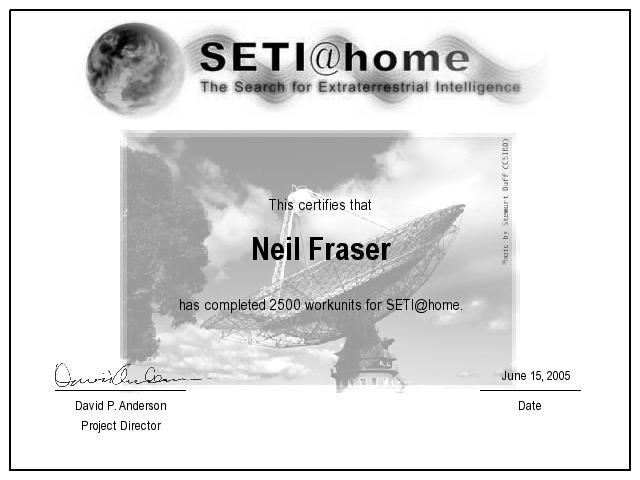
The SETI@home project just sent me another certificate, 2500 work units complete. Still no aliens.
A lot of people have asked why I'm spending my spare CPU cycles on Seti[?], rather than protein folding[?]. After all, the former is an endeavour which probably won't succeed (civilisations probably don't use radio tech for more than a few hundred years), whereas the latter will likely offer cures for diseases such as Alzheimer's, cystic fibrosis and some cancers. It seems pretty obvious that protein folding is more deserving.
But there's a catch. Seti is a now-or-never activity. Every year it becomes more and more difficult to obtain high-quality radio data. As more people buy cell phones, as more satellites are launched, as more ships use over-the-horizon radar, ever increasing terrestrial noise is added to the data. In a few years it will not be possible to conduct serious radio-based Seti observations (short of building observatories on the lunar farside).
That is why I spend my cycles on Seti. We can cure diseases any time, but the door is closing on our ability to listen for neighbours. Once that door closes, then I will happily fold proteins till the cows come home.